
My manifestation journal has more half-finished jawlines doodled in the margins than actual affirmations. That's the honest starting point of this whole soulmate sketch experiment — not a spiritual awakening, just a graphic designer's brain reaching for a face to anchor a love manifestation practice that had gone fuzzy at the edges. Scripting and journaling alone hadn't fixed the actual problem, which was that I didn't know what I was picturing. So I tested four different soulmate visualization services, one after another, to see which one actually shifted my dating mindset instead of just sitting pretty in a notebook.
Quick disclosure before we go further: this post contains affiliate links, and if you order through one I earn a commission at no extra cost to you. I only write about services I've actually paid for and sat with during my own private experiments, never anything sent to me for free.
Okay, hear me out, because I know how this sounds. A while back I picked up a water-stained copy of The Secret at a used bookstore during a stretch of dating burnout, fully expecting to roll my eyes through the whole thing. Not the law-of-attraction, manifest-a-mansion version, but the smaller claim underneath it — that attention follows focus — which felt provable in a way the mansion part never did.
From there I fell into the whole toolkit, quietly, telling absolutely nobody: scripting most mornings (I laid out the nuts and bolts once in a skeptical guide to love scripting), a 369 method round before bed, an affirmation journal I was lowkey mortified to be seen writing in at a coffee shop, a love list I rewrote more times than I would like to admit trying not to sound desperate on the page, a new moon ritual I tried out of curiosity more than belief, the whisper method on a few restless nights, and a digital vision board I kept quietly rebuilding. None of it told me whether any of it was actually working, though, especially right around the point where a practice stops feeling new and starts feeling like homework you half-do. I had also leaned hard into the detachment principle (the idea that gripping an outcome too tightly chokes it), which is easy to say and much harder to do when your hand is cramping somewhere around line forty of a 55x5 round and you are still thinking about someone who has not texted back.
A singles mixer at a wine bar didn't help either — I left after forty minutes because the small talk felt like a networking event with worse lighting. My friend Rhiannon, who spends her weekends building terrariums to sell on Etsy and has watched this whole phase of mine with more amusement than concern, is usually my reality check on this stuff. When I told her I'd ordered four different drawings of a man who doesn't exist, she didn't blink. She just asked if any of them actually looked like someone I'd want to date.
A Vague Attraction List Never Worked For Me
Most dating advice tells you to stay broad: focus on the feeling, don't get hung up on specifics, stay open. In my actual job, that advice would get me fired. You cannot design a brand around "a happy vibe"; you need hex codes, type rules, constraints that force an actual decision. Love manifestation works the same way once you stop treating specificity like it's somehow less spiritual than vagueness.
Asking for "someone who loves to travel" doesn't challenge anything in you. It's comfortable precisely because it demands nothing. Anchor down into an actual face and an actual set of behaviors, though, and your own red flags surface fast; you cannot pretend not to notice emotional unavailability once you've been mentally rehearsing the opposite of it most nights. This was never about replacing anyone specific from my past, either. It was about finally picturing someone who wasn't just the shape of whoever I was still getting over.
There's one evening I keep coming back to: scripting at my kitchen table, coffee gone fully cold beside the notebook, Hinge sitting forgotten on my phone because for once I wasn't checking it. That's the version of this practice that actually does something — not the stock photo of someone gripping a vision board, but the version where the apps stop being the main event for a while.
That shift is what pushed me to treat soulmate sketches less like psychic entertainment and more like a visualization anchor. I landed on the idea less by planning it out than by floating in Barton Springs Pool one slow afternoon, staring at the cypress roots along the bank and running through what I actually wanted instead of what I thought I should want. So I tested four different sketch services, back to back, specifically to see which one held up as a nightly tool instead of a novelty.
Testing Four Services As Visualization Tools
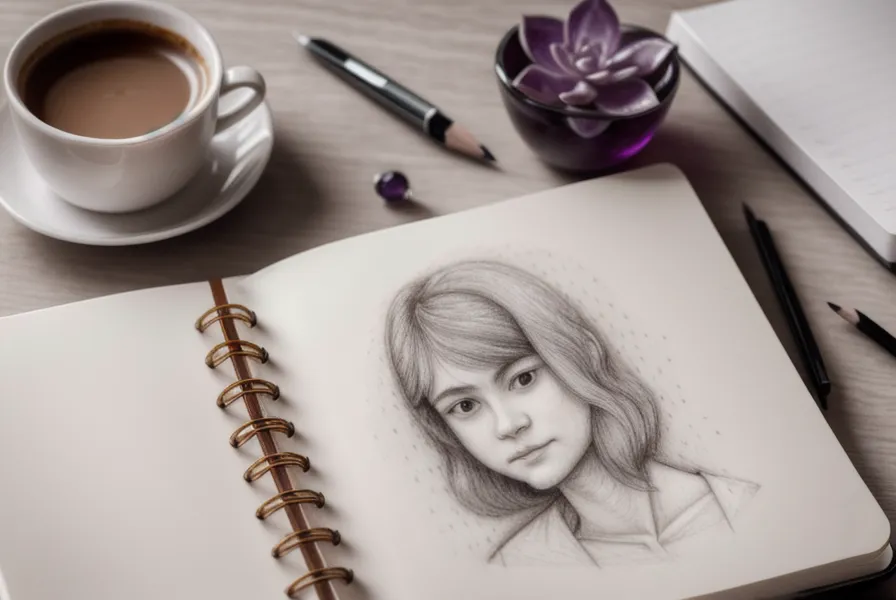
If you've read the longer breakdown where I secretly tested four sketch services, you already know I went in expecting clip art. What I got instead was four genuinely different creative answers to the same assignment: draw a stranger, and make him feel real enough to focus on.
Soulmate Sketch 2.0 Is the Low-Commitment Entry Point
Soulmate Sketch 2.0 felt like the lowest-stakes way in: a short intake form, nothing invasive. The portrait that came back was clean and realistic, the kind of face you'd pass in a grocery store line and not think twice about. The written profile stayed pretty general: he values honesty, he values loyalty, true of basically anyone worth dating. It gave my eyes something to hold onto during a 369 round, but as someone who obsesses over narrative detail for a living, I wanted more texture than "nice guy."
Sloane, someone I know from a manifestation forum who's further along in this than I am, told me later she wished she'd skipped the simplest option first and gone straight for something with an actual personality attached. Fair point. It's a reasonable entry, just not a destination.
Eva Bloom Trades Precision for Mood
Eva Bloom markets itself as artistic expression blended with an energy reading rather than a straightforward likeness, and that description holds up. The lines were softer, almost watercolor, with the kind of unfinished quality you'd get from a cinematic still rather than a passport photo. I liked looking at it right before sleep, in that nighttime window when the rest of the day has finally gone quiet. The tradeoff was that the written reading leaned poetic rather than practical, closer to a mirror than a map. I started treating it the way I'd treat a tarot pull or a horoscope, less a prediction and more a reflection of whatever I already suspected, which gave me a feeling to sit with but not much to check my actual dating decisions against.
Going Deep With Tina Aldea Soulmate Sketch
Tina Aldea Soulmate Sketch sits at the most spiritually dense end of the spectrum. The drawing has real weight to it: dense shading, careful linework around the eyes, something that reads as hand-built rather than templated. What came with it was a long reading about soul-level patterns and friction points, which was genuinely fascinating and, honestly, a lot to sit with. For my evening routine, it sometimes pulled me into over-analyzing esoteric detail instead of just feeling settled before closing my laptop.
Soulmate Story: The One That Changed My Routine
What made Soulmate Story different was pairing the portrait with an actual behavioral profile: not just hair color and build, but how this person handles a disagreement, how he shows up after a rough day, the specific texture of how he'd talk to me day to day. That's a different category of detail than "he values honesty." The portrait itself landed in a middle zone too: distinctive without being hyper-stylized, realistic without being stiff.
Pairing the sketch with something I already did helped more than ordering it on its own would have. I started pinning the portrait to the vision board I'd been quietly rebuilding, stacking tools instead of picking one and abandoning the rest. And the sketch itself wasn't predicting anything, which matters, because that's not what it's for. It was clarifying a question about what I actually wanted that I'd been dodging for a while.
Having a profile with that much behavioral specificity changed the actual exercise. Instead of picturing a vague guy across a vague dinner table, I had a working narrative: sitting on a couch, working through a disagreement with someone whose likely reactions I already had a sense of.
Which of These Four Actually Earns a Spot in a Nightly Routine?
Every one of these serves a different temperament, and the real question isn't which service is most popular, it's which one matches whatever your own practice is actually missing. Details on each can shift over time, so I'd check each vendor's own page directly rather than take my word as current.
Start with Soulmate Sketch 2.0 if you want the fastest, lowest-commitment way to put a face on a vague practice. Just don't expect the written profile to do much heavy lifting. Reach for Eva Bloom if mood and artistic atmosphere matter more to you than a usable behavioral script, since that one actually gets looked at during a visualization session instead of ignored. Choose Tina Aldea Soulmate Sketch when you want the deepest spiritual framing and don't mind a reading dense enough to sit with for a while. And if what you're actually missing is a specific, workable anchor for nightly scripting (something closer to a character brief than a face), Soulmate Story is the one that did that for me.
| Product | Rating | |
|---|---|---|
| Soulmate Story Top Pick | 9.2 | Read More → |
| Tina Aldea Soulmate Sketch | 8.8 | Read More → |
| Eva Bloom | 8.4 | Read More → |
| Soulmate Sketch 2.0 | 7.9 | Read More → |
Soulmate Story
Pros
- ● Delivered digitally within a crisp 24-hour window
- ● Includes actionable behavioral and communication personality traits
- ● Balances realistic portraiture with grounded emotional depth
- ● Provides an immediate visual focal point for the 369 method
Cons
- ▹ Requires open-minded emotional regulation to apply effectively
- ▹ No live 1-on-1 coaching or personal consultation included
From Wishing to Rehearsal
Before anyone accuses me of handing my love life over to internet drawings: I am not a licensed therapist, a clinical psychologist, or a certified relationship coach. I have zero credentials in mental health. If you are dealing with real trauma, serious dating burnout, or clinical depression, please talk to a licensed professional instead of resting your emotional well-being on an online sketch.
What I am is someone who noticed how powerfully my brain responds to visual constraints. A full stretch of open-ended scripting left my imagination lazy. I let real red flags slide on actual dates because I had convinced myself that manifesting meant staying open-minded about everything, including things that deserved less patience than I gave them.
Having a concrete portrait pinned inside my notebook (something I wrote about more when I covered why I used a soulmate sketch on my vision board) created an actual filter. Sitting down for a 369 sequence at night, my nervous system finally had a reference point instead of an ambiguous prince-charming outline. I've also gotten more honest about the difference between an actual sign and a coincidence I wanted badly enough to call one, which turned out to be its own kind of homework.
My relationship with dating apps flipped after that. The compulsive checking stopped. The anxiety over a slow reply mostly dissolved. The mental anchor built through Soulmate Story made it obvious within the first fifteen minutes of meeting someone whether they actually fit what I'd been rehearsing, or just looked fine on paper.
If you've been scribbling intentions in coffee shops, feeling a little silly, and wondering why your actual dating patterns haven't budged, it might be worth asking whether your brain just needs a clearer visual coordinate rather than another vague affirmation. Ordering one feels a bit embarrassing. Having an actual mirror in front of you tends to be worth that moment of embarrassment.